Tools you'll need
- Tape measure
- Pencil
- Carpenter square
- Miter saw or circular saw
- Jigsaw - For the entry cutout
- Drill / driver
- Bar clamps
- Hammer - For roof shingles
- Utility knife - For shingles
- Safety glasses
Materials
- 4 boards, 8 ft 2x2 pressure-treated - Frame and skids
- 1 sheet, 4×8 ft 3/4" exterior plywood - Floor, walls, roof
- 6 boards, 8 ft 1x4 cedar trim - Corner trim and entry framing
- ~20 sq ft Asphalt roof shingles - A bundle covers two dog houses
- ~20 sq ft 15 lb roofing felt
- 1 sheet, 4×8 ft 1 1/2" rigid foam insulation - Walls and roof
- ~80 #8 × 2 1/2" exterior screws
- 1 lb Roofing nails
- 2 Galvanized hinge - For the cleanout roof
- 1 quart Exterior wood stain or paint
Skip the math - the Fixie iOS app generates a per-project cut list for the exact dimensions you pick, with kerf accounted for and one-tap sourcing for the lumber.
Step by step
Build the floor frame
Cut four 2x2s — two at 32", two at 21" — and assemble into a rectangle using exterior screws. Add a center crosspiece for support. Cap the bottom with a piece of plywood cut to 32"×24".
Add the skids
Cut two 32" 2x2 skids and screw them under the floor frame, parallel to the long sides. The skids lift the floor 1 1/2" off the ground — critical for keeping the inside dry.
Frame and sheath the four walls
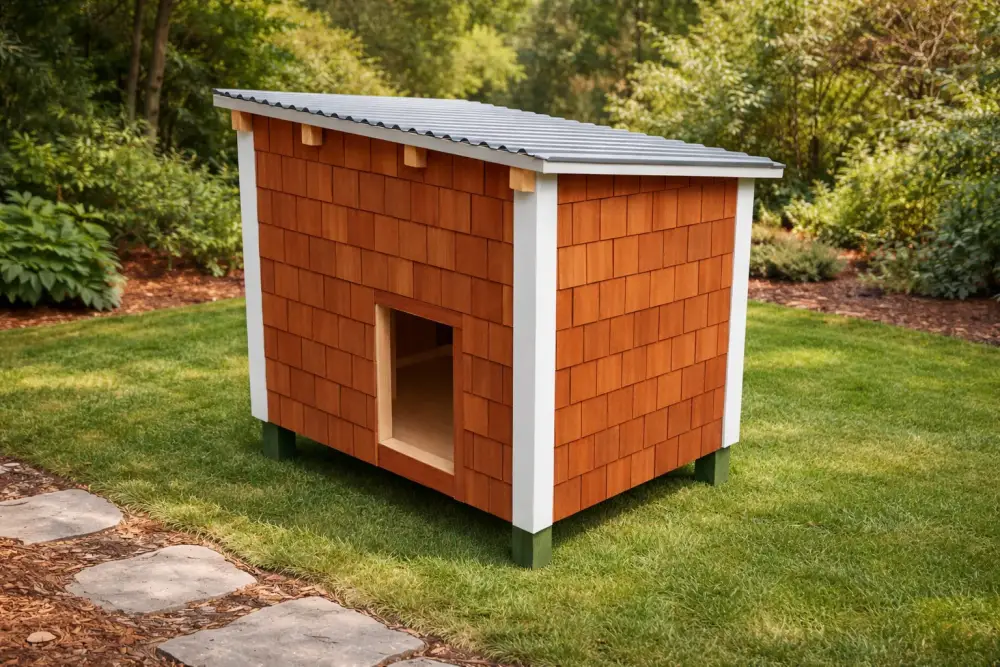
Build each wall as a frame of 2x2s, then sheath with plywood cut to size. The front wall needs an entry cutout — for a 40–60 lb dog, 8"×12", offset to one side so the dog can curl up out of the wind.
Insulate the walls
Cut rigid foam to fit the inside of each wall cavity. Friction-fit it between the 2x2 framing. Insulation makes a real difference in winter — dogs lose heat fast through bare plywood.
Cover the inside with thin plywood
1/4" plywood on the inside protects the insulation and gives a clean surface. Pre-drill and screw it to the framing.
Assemble the box
Stand all four walls up on the floor and screw them together at the corners. Drive screws through the floor frame up into the wall framing too — this is what keeps the box rigid.
Build the sloped roof
Cut a piece of plywood for the roof, sized to overhang each side by 2". Slope it from front to back by raising the front wall 2" higher than the back. Cover with roofing felt, then asphalt shingles starting from the bottom edge and overlapping each course.
Hinge the roof for cleaning
Attach the roof to the back wall with two galvanized hinges. This lets you flip the roof open for cleaning and bedding swap-outs. Add a small hook-and-eye latch on the front to keep it closed.
Trim and finish
Apply 1x4 cedar trim around all corners and around the entry hole — it covers the plywood edges and looks finished. Finish with exterior stain or paint, but skip the inside (your dog doesn't care, and untreated interiors are healthier).
Tips
- Orient the entry away from prevailing wind. North or east-facing entries stay drier.
- Raise the dog house off the ground at least 1 1/2" — moisture from below is the #1 cause of rot.
- Skip the door flap unless you live somewhere very cold. Dogs prefer to see the entry clearly.
- Use a removable cushion or straw as bedding — both can be cleaned. Avoid blankets in damp climates.
- In winter, position the dog house against a wall or fence for windbreak.
FAQ
What size dog house do I need?
The interior should be 25% larger than your dog when curled up — big enough to turn around, not so big they lose body heat. The 32"×24" plan here fits 40–60 lb dogs. Add 4" each direction for every 20 lb above that.
Should the dog house be insulated?
If you live anywhere with winters below freezing, yes. Rigid foam between the wall framing adds maybe $20 in materials and dramatically improves comfort. In mild climates, you can skip it.
How do I keep it from rotting?
Raise it off the ground on skids, slope the roof, use exterior-grade fasteners and finish, and use cedar or pressure-treated lumber for any framing that touches the ground. The roof shingles also matter — cheap roofing fails in 2–3 years; midgrade asphalt shingles last 15+.
Can I just buy a dog house?
Yes. Plastic ones run $80–$200 and are fine for mild climates. Building one matters when you want it to fit your dog specifically, last decades, or match your home aesthetics. Many dog owners build one because the dog is their first "client" and the project is forgiving.
Build it, guided every step
The Fixie iOS app turns this plan into a customized build for your exact space - pick your dimensions, get an auto-generated cut list, order materials in one tap, and follow the steps with 3D previews. Have something else in mind? Describe it or snap a photo and Fixie will design your own build from scratch - your first design is free.
Download Fixie on the App StoreMore beginner projects